Xanalogical Structure: Now More Than Ever

TL;DR
- ✓ The modern web is failing due to fragile HTTP links and link rot.
- ✓ Ted Nelson's Xanalogical structure offers a path to a truly interconnected digital universe.
- ✓ Transclusion preserves content lineage by creating live windows into original source documents.
- ✓ Bidirectional linking transforms isolated silos into a coherent, verifiable graph of human knowledge.
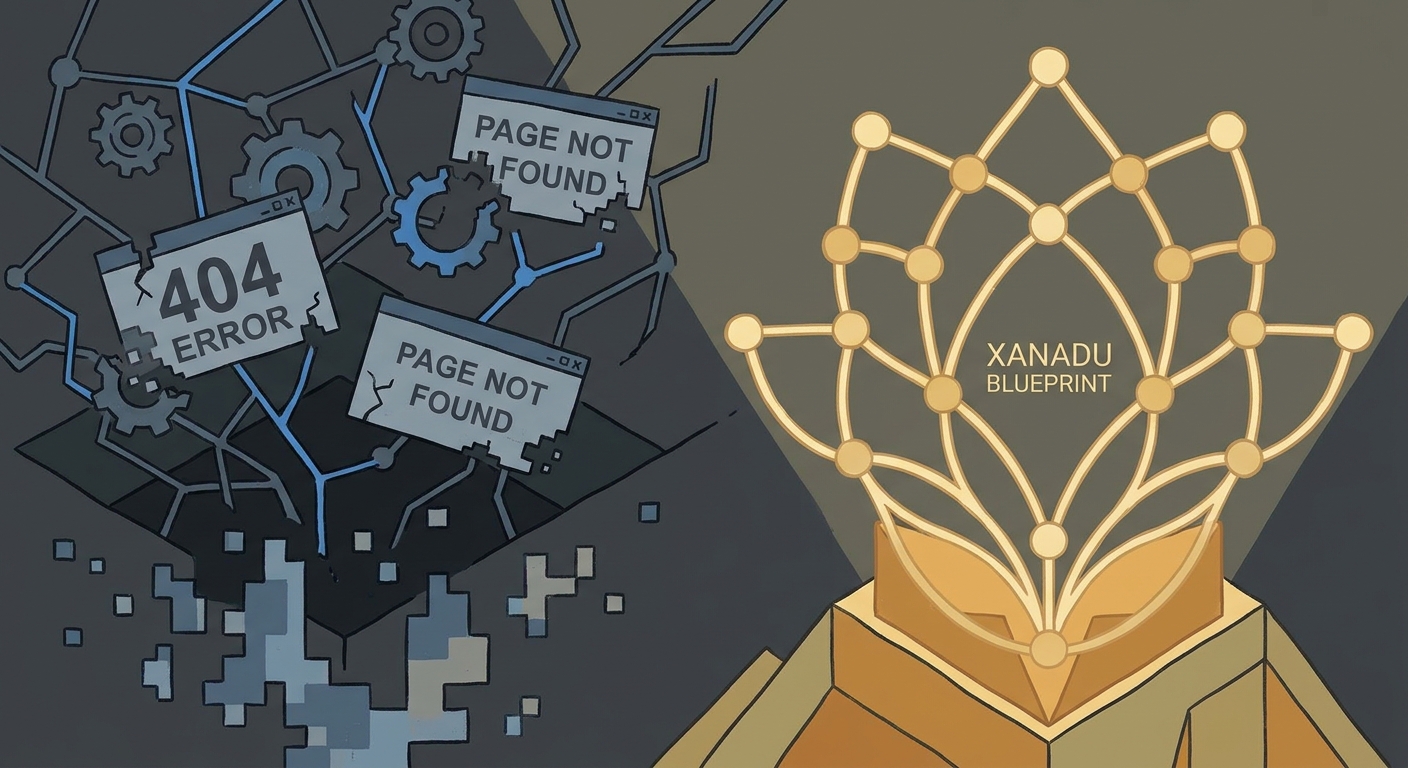
The modern web is a graveyard. It’s a sprawling, digital landfill of broken promises and "404 Not Found" errors where information goes to die. We’re currently watching the hyperlinked ideal collapse in real-time. Our current standard—HTTP—is brittle. It’s a flimsy foundation that makes it impossible to maintain an honest, traceable, or permanent record of human thought.
If we want to fix this, we need to look backward to move forward. We need the blueprint laid out by Ted Nelson, the visionary behind Project Xanadu. His concept of "Xanalogical" structure isn't just a technical fix; it’s a path back to a coherent, interconnected, and verifiable digital universe.
Why is the Web Falling Apart? (The Failure of HTTP)
The web wasn’t supposed to be this fragile. When Tim Berners-Lee handed us the browser, he gave us a simplified, one-way version of a much grander vision.
Think about how a link works today. It’s just a pointer—a fragile, unidirectional street that directs you to a file at a specific address. If that address changes? If a server goes offline? If a site owner decides to clean house? The link snaps. This is "link rot," and it’s the defining sickness of our era.
We’ve treated the web as a collection of isolated silos instead of a fluid, singular document space. When you move a file, you break the connection. When you copy content from one site to another, you sever the provenance. The result? A floating piece of data with no tether to its origin. This is the exact opposite of Ted Nelson’s original vision, which treated all documents as parts of one continuous, deeply interlinked whole.
Today’s web is a series of walled gardens. The Xanalogical web is meant to be a living, breathing ecosystem.
What is the Xanalogical Structure and Why Does it Matter?
At the heart of the Xanalogical philosophy is a beautiful, messy word: "intertwingularity." Nelson coined it to describe the reality that everything is deeply connected. If we can't map those connections, it’s not because the world is chaotic—it’s because our tools are failing us.
To reclaim the web, we need to adopt three pillars: transclusion, bidirectional links, and micro-payments.
Transclusion is the heavy hitter. Our current "copy-paste" culture is destructive; it creates disconnected clones. Transclusion is different. It allows you to reference a piece of content in its original context. When you "quote" someone via transclusion, you aren't just stealing their text; you’re creating a live, dynamic window into the source. If the author updates their work, your reference updates automatically. It preserves the lineage of thought.
Bidirectional links are the second pillar. In our current system, Document A points to Document B, but Document B has no idea it’s being referenced. Bidirectional linking ensures that if A talks to B, B knows it. This builds a graph of knowledge rather than a rigid hierarchy of folders.
Finally, micro-payments act as the economic glue. They ensure creators are compensated for their work regardless of how it’s cited or transcluded. It aligns the incentives of the information economy with the actual needs of the authors.
How Can Transclusion Solve the AI Attribution Crisis?
We are drowning in a sea of AI-generated hallucinations. Large Language Models eat massive datasets, strip the context from that information, and spit it back out in a way that sounds authoritative but lacks any verifiable trail of evidence. It’s the ultimate "copy-paste" failure. Because the AI doesn't know where the information came from, it can't prove it’s telling the truth.
Transclusion is the antidote. If we force AI models to function within a framework of "virtual quotation," every claim becomes tethered to a live, immutable source.
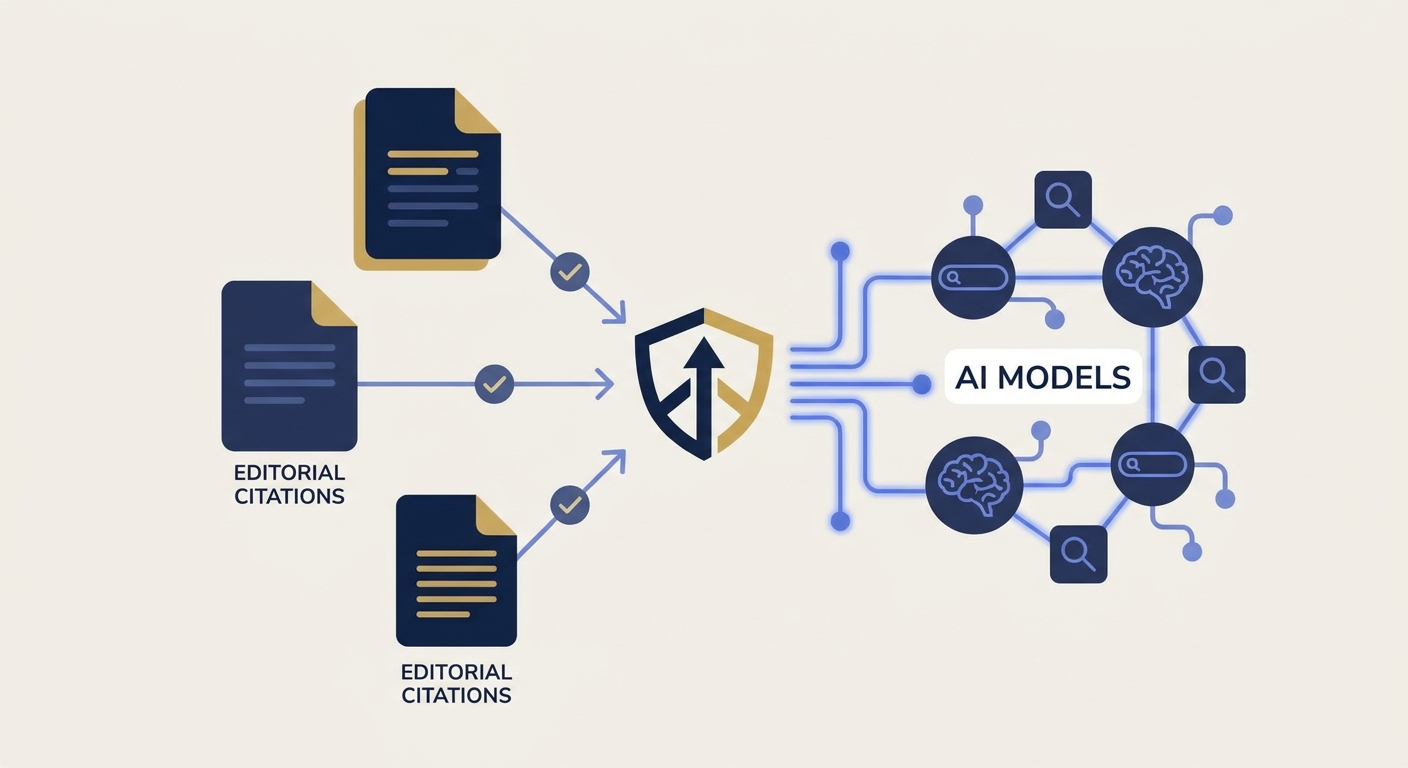
When an AI provides an answer, it shouldn't be "creating" text—it should be orchestrating a transclusion of verified, high-quality sources. This creates a trail of breadcrumbs for the reader to follow, verify, and debate. It turns the "black box" of AI into a transparent, navigable network of human intelligence.
Are We Entering a Personal Knowledge Management (PKM) Renaissance?
Look at the desktops of researchers, developers, and writers today. A quiet revolution is happening. Tools like Obsidian, Roam, and Logseq aren't just note-taking apps; they are the first widespread applications of Xanalogical principles.
People are ditching the "folder-file" hierarchy—a relic of 1980s operating systems—in favor of graph-based, bidirectional thought networks. This shift is a direct reaction to the failure of the modern web. People are tired of losing their own knowledge to the entropy of the cloud. They want to build a personal "Docuverse" where every note is linked and every reference is active.
If you want to bring this level of coherence to your business, our Content Strategy Framework is designed to help you move away from static, siloed pages and toward this networked, entity-based approach.
How Can You Apply Xanalogical Principles to Your Website Today?
You don't need to build a new internet to start thinking in a Xanalogical way. Start by changing how you structure your own content. Stop thinking in terms of "pages" and start thinking in terms of "entities." Every piece of content you produce should be a node in a larger, interconnected web.
Implement robust, bidirectional internal linking. When you mention a concept, link it back to a core "pillar" page. Ensure that your pillar page lists every instance where that concept is discussed. This mimics the graph-based structure of a true hypertext system. By focusing your architecture on these connections, you improve your site’s internal authority and user experience—which is vital as search engines move toward The Future of SEO, where semantic connections matter far more than shallow keyword matching.
Beyond the Link: The Future of Digital Sovereignty
Digital sovereignty is the ability to own your contribution to the global knowledge pool. Right now, our work is trapped in platforms that can disappear or change their terms of service on a whim. The Xanalogical vision, championed today by groups like The Future of Text Initiative, is about reclaiming the permanence of our words.
When we move toward permanent, non-broken references, we stop being renters of our digital history and start being architects of it. The "Docuverse" isn't a fantasy. It’s an engineering goal. It’s the realization that the digital world should be as stable, as interconnected, and as reliable as a physical library—but with the added power of infinite, instantaneous access.
Conclusion: Embracing the Intertwingled Web
The web we have is an accident of history. The web we need is a deliberate choice. We cannot keep building on the shifting sands of broken links and disconnected data. By adopting the Xanalogical structure—by prioritizing transclusion, honoring the bidirectional nature of human thought, and demanding provenance from our AI tools—we can transform the internet from a chaotic, rotting mess into a sustainable, truthful ecosystem of human knowledge. The intertwingled web isn't just a dream. It’s the only path forward.
Frequently Asked Questions
What does "Xanalogical" actually mean?
It is a fusion of "analog"—referring to the fluid, continuous nature of human document flow—and "digital" hypertext. It represents a system where documents are not isolated files, but parts of a larger, interconnected, and immutable whole.
Why didn't the Web become Xanalogical originally?
The simplicity of HTTP’s unidirectional, "pointer-based" links allowed for rapid, low-barrier adoption in the early 1990s. While Xanadu offered a superior, more robust architecture, it was technologically complex to implement at scale, causing the "simpler" web to win the race for adoption.
How can I apply Xanalogical principles to my website today?
Focus on transitioning from a hierarchical folder structure to an entity-based, graph-like structure. Implement bidirectional linking, ensure your metadata is rich enough to support provenance, and prioritize deep-linking between your content clusters instead of relying solely on shallow, top-level navigation.
Can transclusion help with copyright issues in AI?
Yes. By using dynamic referencing (transclusion), AI models can display content from original sources while maintaining an active link to the creator. This ensures that the original author retains control and receives proper attribution, turning AI from a platform that "steals" content into one that "curates" and cites it.