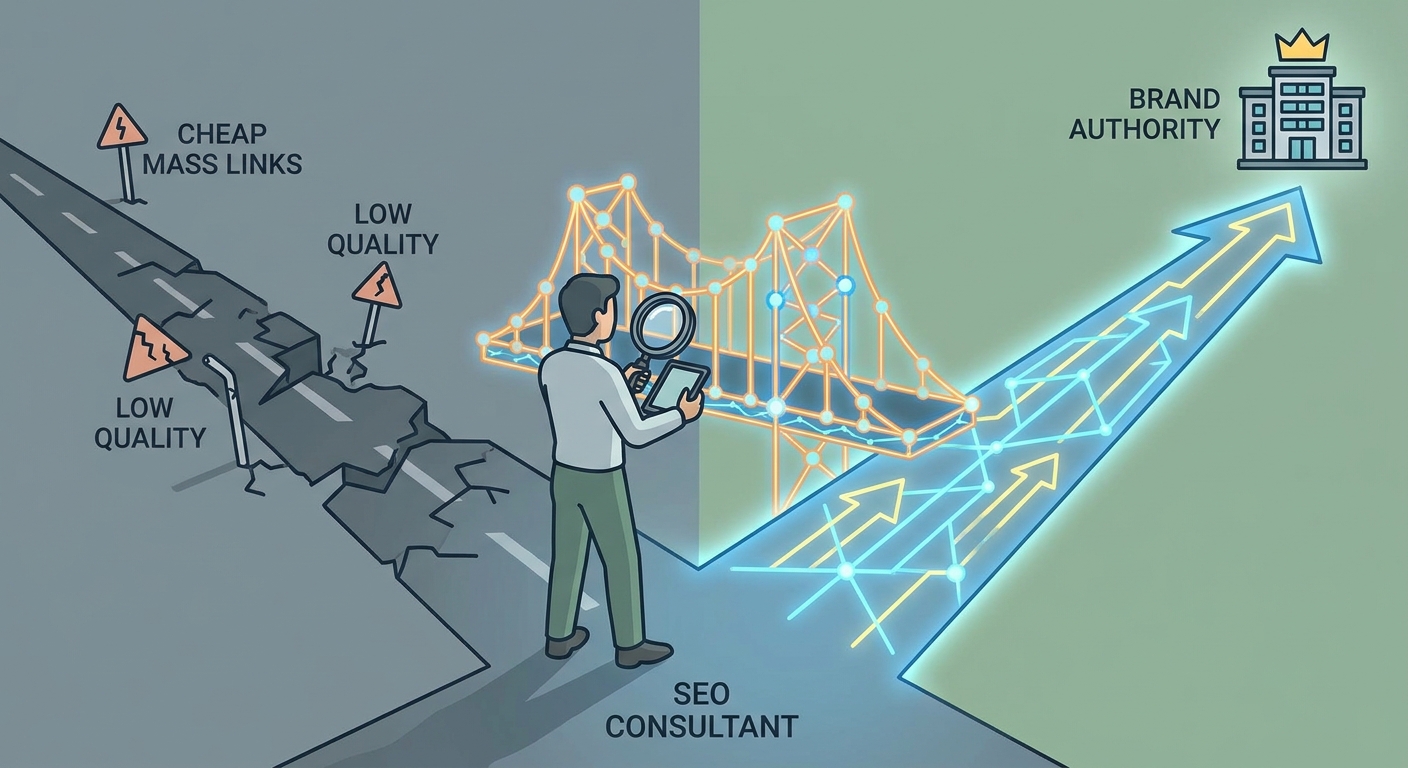
Link Portfolio Management: Avoiding Penalties with Backlink Quality Assessment

TL;DR
- ✓ Treat your backlink profile as a vital financial asset needing quarterly maintenance.
- ✓ Distinguish between harmless organic web noise and dangerous manipulative link patterns.
- ✓ Implement a proactive assessment cycle to prevent long-term algorithmic suppression.
- ✓ Use a multi-source data aggregation strategy to eliminate blind spots in analysis.
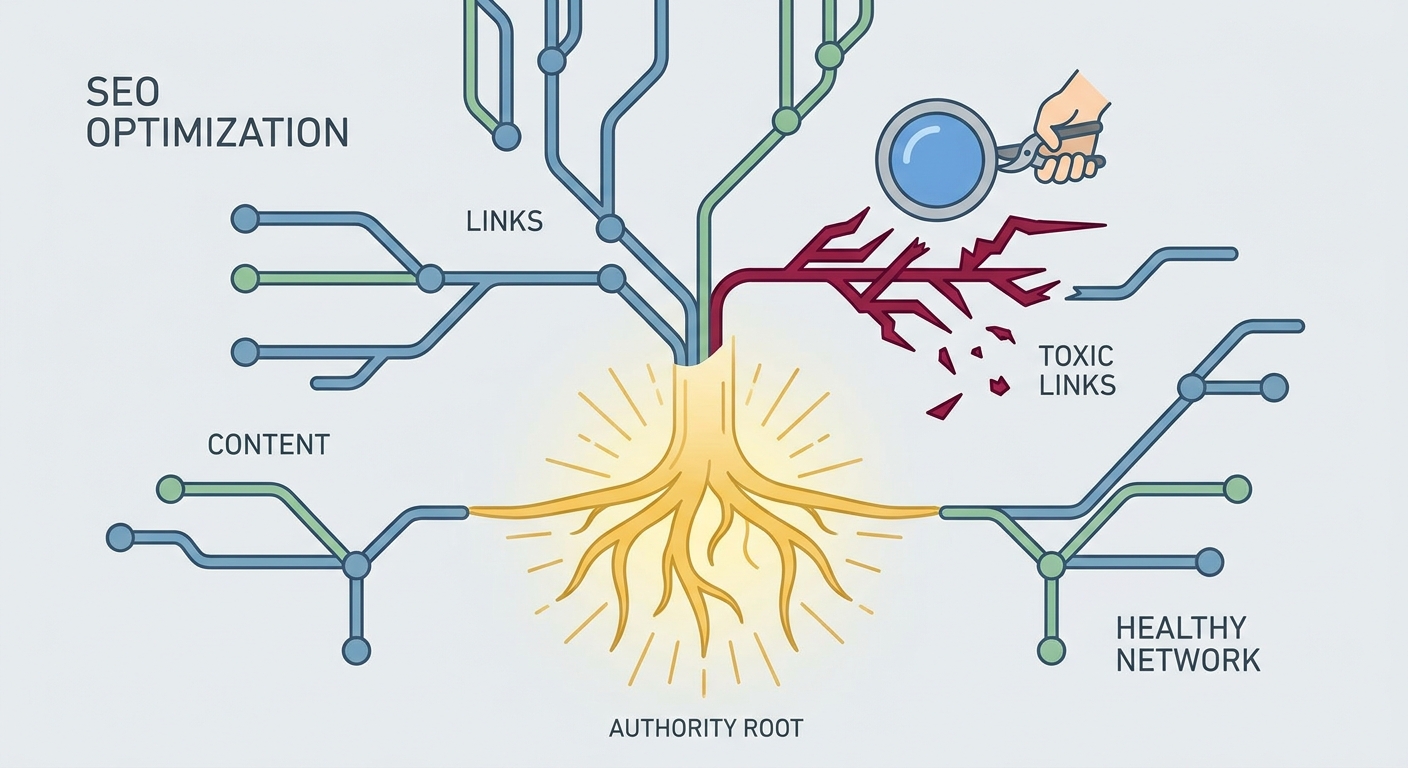
Your backlink profile isn't just a spreadsheet of URLs. It’s the actual root system of your website’s authority. In 2026, if you’re still treating your link profile as a "set-it-and-forget-it" asset, you’re just waiting for a disaster.
Algorithmic resilience—the ability of your site to survive the constant churn of search updates—depends on one thing: your ability to tell the difference between messy, natural growth and the kind of manipulative patterns that trigger Google’s SpamBrain. Effective link portfolio management is the high-level art of nurturing your site’s reputation. It’s about making sure your hard-earned authority doesn't get watered down or tanked by the inevitable pile-up of low-quality web debris.
The SEO Root System: Framing the Asset
Think of your website as a garden. You can plant the best seeds—brilliant content and rock-solid engineering—but if you ignore the weeds, they’ll eventually choke your growth. In today’s search landscape, "Organic Spam" is a fact of life. Every site with a pulse eventually attracts low-quality links from scrapers, automated networks, and random, unrelated directories.
The danger isn't the existence of a few bad links; it's the pattern of those links. Google’s algorithms are getting smarter at ignoring the noise, but when your profile shows a distinct signal of artificial manipulation, you’re practically asking for a penalty. Stop the reactive, fear-based link removal. Shift to a proactive, quarterly assessment strategy. You’re protecting a financial asset. When you consider that a quality B2B editorial link can cost upwards of $500, failing to protect your existing equity is essentially letting money rot in the ground.
Why Is Your Backlink Profile Like a Garden?
An effective link audit isn't a one-time emergency cleanup. It’s a habit. You need to build a cadence—ideally quarterly—to monitor the health of your incoming links. This prevents the "boiling frog" scenario, where your site slowly bleeds authority over months because of a growing, unchecked spam problem.
By institutionalizing this cycle, you stop panicking and start managing. You’re looking for the gap between natural "web noise" and "algorithmic suppression," which happens when your site’s link velocity or anchor text distribution starts looking weird compared to the rest of your industry.
How Do You Aggregate Data Without Blind Spots?
The 2024 mistake of relying on a single tool for link data is a recipe for disaster. No single index holds every link on the web. To get a true picture of your profile, you need the "mandatory trinity": your own Google Search Console (GSC) data, a deep-crawl tool like the Ahrefs Backlink Checker, and a third-party crawler to catch the edge cases.
Relying solely on GSC? You’re blind to links that haven't triggered a crawl yet. Relying only on a third-party tool? You’ll miss the specific links Google has already flagged or indexed for your property. By merging these data sets, you create a master list. This aggregation phase is exactly where you identify the "hidden" spam networks that might be flying under the radar of a less diligent audit.
What Is the Evaluation Matrix for Quality?
Once you have your data, the evaluation matrix becomes your primary filter. The most common pitfall? Over-indexing on metrics like Domain Rating (DR) or Domain Authority (DA). A DR 80 site with zero topical relevance is often far less valuable—and potentially more dangerous—than a DR 20 site that sits perfectly within your niche.
When assessing links, look for "SpamBrain" triggers. These include:
- Link Velocity Anomalies: A sudden, inexplicable spike in links from domains that have no thematic connection to your industry.
- Anchor Text Over-Optimization: If 80% of your links use exact-match commercial keywords, you are broadcasting intent to manipulate rankings.
- Patterned Footprints: Links coming from networks that share the same IP range, hosting provider, or template design.
For a deeper dive into what Google considers unacceptable, review Google’s Webmaster Guidelines on Link Schemes. It is the definitive baseline for what constitutes a violation.
Should I Disavow, Ignore, or Reach Out?
Not every bad link needs to be nuked. In fact, aggressive disavowing is one of the fastest ways to accidentally strip your own site of legitimate, though weak, link equity. Use this decision tree to guide your actions:
If a link is clearly part of a private blog network (PBN) or a paid link scheme, use the Google Search Console Disavow Tool Guide to signal to Google that you don't want to be associated with that domain. However, if the link is just low-quality—perhaps from a small, neglected blog—Google’s algorithms are usually smart enough to simply ignore it. Don't waste your energy or risk your equity by disavowing natural, albeit weak, links.
From Cleanup to Growth: How Do You Find New Opportunities?
The most overlooked aspect of an audit is its ability to inform your future growth. When you analyze your existing profile, you are essentially looking at a map of where your audience lives online.
If you find a high-quality, relevant site that has linked to you, that domain is a "lookalike" target. You can use your audit data to find 10 or 20 similar sites that haven't linked to you yet. This transforms a defensive cleanup project into a proactive outreach campaign. If you find the manual labor of these audits too taxing, our SEO Audit Services specialize in identifying these growth bridges while keeping your profile pristine.
Case Study: Recovering from Algorithmic Suppression
Consider a client who came to us after a significant drop in organic traffic. Their profile was riddled with thousands of low-quality links accumulated over a decade of aggressive SEO. They had previously attempted to fix this by using an automated "toxic link removal" tool, which resulted in them disavowing nearly 30% of their legitimate, high-authority links.
Our recovery strategy was simple: we revoked the bulk of the disavow file, keeping only the most egregious, clearly manipulative spam. We then focused on building high-quality, topically relevant content that naturally attracted links. Within six months, as the algorithmic dust settled and the site’s "natural" profile regained its weight, visibility recovered. The lesson: "less is more." When cleaning your profile, precision is always better than volume.
Future-Proofing: How Do You Build Links That Last?
The best defense against future updates is a strategy that focuses on editorial quality. Digital PR and earning unlinked brand mentions are the gold standards of 2026. When you stop chasing "links" and start chasing "mentions" and "relationships," you build a profile that is inherently difficult for competitors to replicate and for Google to devalue.
Editorial links—those earned through genuine value, research, or unique data—are the ultimate shield. They signal to search engines that your site is a trusted authority, not a site that plays games with the algorithm. For those looking to pivot away from risky tactics, our guide on How to Build High-Quality Backlinks provides a framework for sustainable, long-term growth.
Frequently Asked Questions
How often should I audit my backlink profile in 2026?
Quarterly is the industry standard for most businesses. If you are in a highly competitive vertical or are actively engaged in aggressive link building, monthly audits are recommended to catch potential issues before they become patterns.
Does Google still penalize for 'toxic' links, or do they just ignore them?
It is usually a mix. Google’s SpamBrain is highly effective at ignoring low-quality links. However, if your profile displays a systematic pattern of manipulative link building, the algorithm may apply a site-wide suppression, which effectively functions as a penalty.
What is the biggest mistake people make when using the Google Disavow Tool?
The biggest mistake is "over-disavowing." Many site owners treat the disavow tool as a "spring cleaning" device and submit lists of thousands of links that are simply low-quality but natural. This can strip your site of legitimate link equity and damage your rankings.
Is it possible to recover from a manual penalty just by cleaning links?
Cleaning the links is only half the battle. To recover from a manual penalty, you must demonstrate to Google that you have taken proactive steps to remove or disavow the manipulative links, and then submit a formal reconsideration request.