The Xanadu Dream

TL;DR
- ✓ Ted Nelson's Xanadu vision offers a solution to modern digital information decay.
- ✓ One-way links cause link rot which damages your site's search authority rankings.
- ✓ Building a cohesive knowledge graph helps AI agents better understand your content.
- ✓ Modern SEO requires moving beyond simple keywords toward robust information architecture.
Modern search engine optimization is suffering from a collective case of amnesia. We’ve spent years obsessing over keyword density and the "how" of ranking, all while completely ignoring the "why" of information architecture.
Enter the Xanadu Dream.
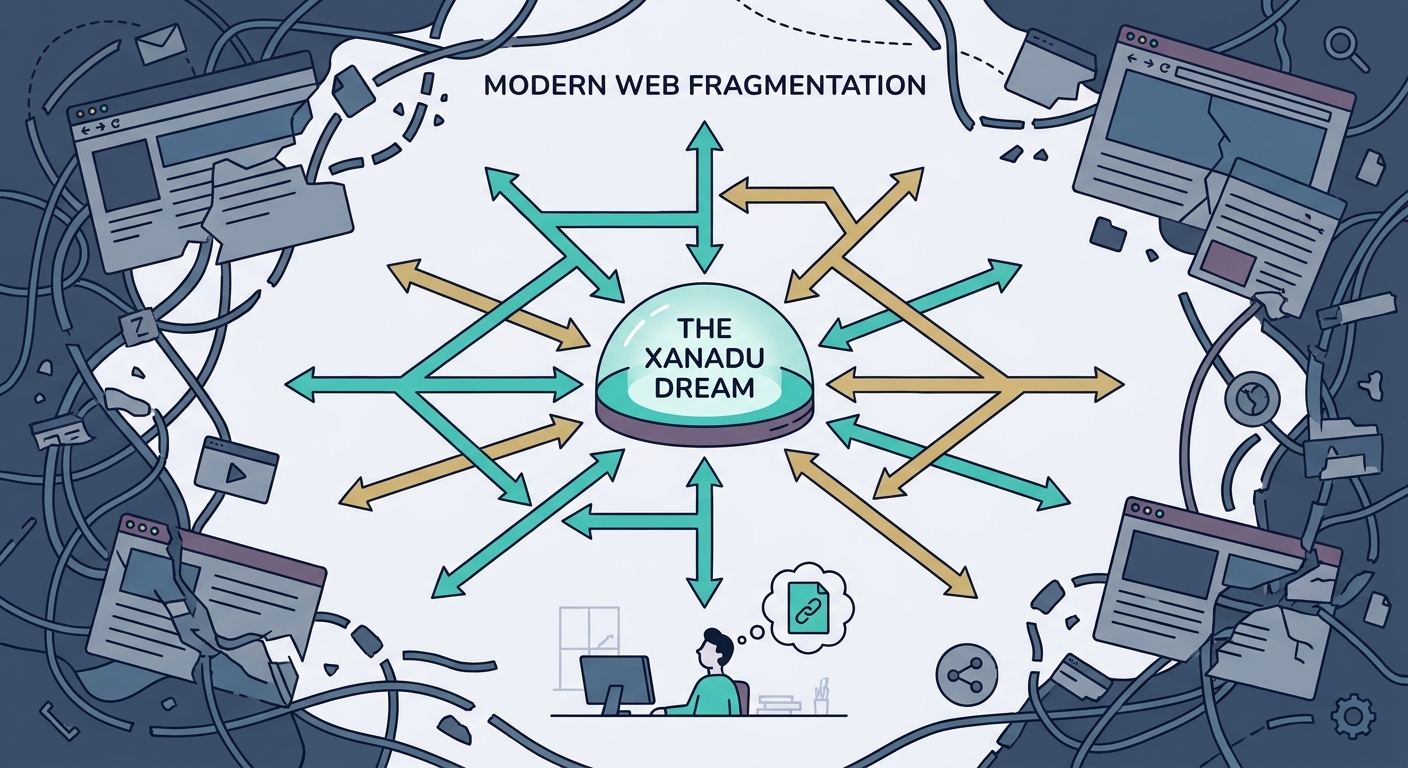
First dreamed up by Ted Nelson in the 1960s, this vision for a universal, persistent, and bidirectional hypertext system is the shot in the arm the digital world desperately needs. While the web we built turned into a fragile, one-way mess of broken links and ghost-town content, Nelson saw something better. He envisioned a world where every connection is two-way, every citation is etched in stone, and every piece of content lives inside a verifiable, living knowledge graph.
Fast forward to 2026. If you’re still trying to "rank" individual pages like it’s 2012, you’re losing. The best SEO strategy now isn't about gaming a list; it’s about building a digital structure that fights off decay and actually makes sense to the AI agents currently scouring the web.
What Was the Xanadu Dream, and Why Did the Web Take a Different Path?
Back in the sixties, Ted Nelson wasn't just thinking about computers; he was thinking about the "docuverse." He saw a future where information wasn't trapped in lonely silos but woven into a single, cohesive fabric. He imagined links that weren't just signposts pointing into the void—they were windows. If you quoted a paragraph from another source, the system would create a "zippered" connection back to the original. As Nelson detailed in his original vision for Xanadu, the goal was simple: kill the "dead end."
But the web didn't go that way. We chose the path of least resistance. HTML won because it was easy, not because it was robust. Our links are one-way streets. They’re fragile, unmanaged, and prone to "link rot." When a destination page moves or dies, the link breaks, leaving your reader—and Google’s bots—stranded in a digital alleyway.
For a long time, this "good enough" approach worked. But today, the volume of content is staggering. The cost of our laziness? A systemic failure in how we retrieve and trust information.
How is "Link Rot" Impacting Your Search Authority in 2026?
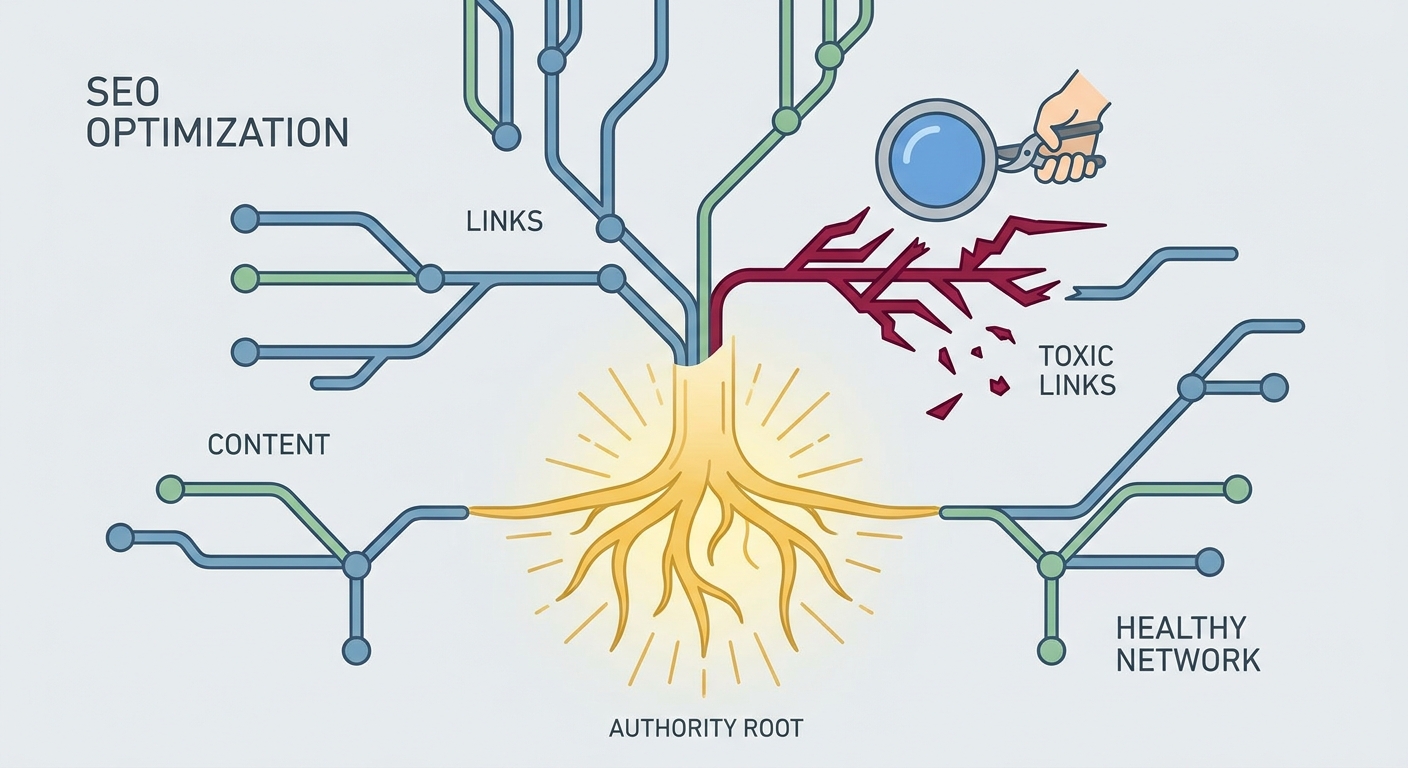
Most SEO audits ignore the lifecycle of a link. That’s a mistake. A link is a heartbeat; when it stops, your site looks dead. Every time an outbound link on your site leads to a 404 error, you’re telling the search crawlers that your content is unmaintained, unreliable, and abandoned. This problem of link rot isn't just a technical glitch; it’s a tax on your domain’s authority.
In 2026, Google’s algorithms are getting terrifyingly good at spotting "dead ends." When a crawler follows a chain of links only to hit a graveyard of deleted posts, the signal is clear: this site isn't a source of truth. It’s a source of noise.
The SEO penalty here isn't a manual action you can appeal; it’s the cold, hard logic of AI models that prioritize "information density" and "structural integrity." If you aren't auditing your links with the same ferocity you use for your keyword research, you are actively bleeding search equity.
Can You Rebuild Your Site to Mimic a Xanadu-Style Knowledge Graph?
The pivot from "siloed pages" to "interconnected clusters" is the real challenge for the modern SEO pro. You need to stop treating your website like a collection of isolated blog posts and start treating it like a living organism. Say goodbye to the "hub-and-spoke" models of the early 2010s; we’re moving toward a truly bidirectional infrastructure.
Bidirectional linking—where pages acknowledge both their supporting arguments and the places they are being cited—creates a self-reinforcing loop of topical authority. When you build this way, you give search engines a map, not a scavenger hunt. Instead of relying on one "pillar page" to do all the heavy lifting, you’re building a web of context that makes it impossible for an AI to misunderstand your site's focus. We often help clients navigate this transition through our internal linking strategy guide to ensure their architecture supports this kind of deep, semantic connectivity.
Visualizing the Semantic Web: How AI Search Interprets Your Content
Modern AI search engines like SearchGPT don't "read" keywords the way humans do. They parse relationships. They look for the semantic distance between concepts. If your content is siloed, the AI gets lost. If your content is structured like a Xanadu-style knowledge graph, the AI can traverse your domain with ease, identifying the hierarchy of your arguments and rewarding you with higher visibility for complex, intent-heavy queries.
By connecting your topics bidirectionally, you eliminate those "dead end" zones. You create a dense network of meaning. AI crawlers love this map-like structure because it lets them verify your expertise across multiple nodes at once.
How Can You Optimize Link Usability for Both Humans and Algorithms?
The "UX-SEO intersection" is a crowded space, but the biggest failure is still the anchor text. If you're still writing "click here," stop. Immediately. It fails Fitt’s Law by providing zero context for the user, and it fails SEO by offering no semantic signal to the crawler. As noted in the art of hyperlinking, your link text should serve as a descriptive bridge. It should tell both the human and the bot exactly what to expect on the other side.
Want to optimize? Make your links descriptive, weave them naturally into your narrative, and—for the love of all that is holy—keep them working. When you guide a user through your content with clear, relevant anchor text, you aren't just lowering your bounce rate; you’re building a path that search engines can follow to discover the depth of your expertise.
Is Your Content Strategy Ready for the Next Evolution of the Web?
There is a massive temptation to wait for the "perfect" architecture—some fully automated, version-controlled repository of all your knowledge. Don't fall for it. The history of the Xanadu project teaches us that shipping a functional system today is infinitely better than waiting for a perfect one tomorrow. You don't need a custom-built database to start. Start by auditing your current content, fixing those broken links, and creating back-references in your existing blog posts.
If you find that your internal linking has become a tangled mess of legacy content, consider reaching out for content audit services to help identify the "rot" that is holding your site back. Remember: versioning is key. When you update an old article, don't just overwrite it; create a connection to the previous version or ensure the new content maintains the "thread" of the original argument. This prevents the loss of historical authority and keeps your knowledge graph growing, rather than resetting every time you hit "update."
Conclusion: Balancing the Xanadu Ideal with Practical SEO
We have spent twenty years playing a game of "link building," trying to hoard external votes for our pages. It’s time to graduate to "knowledge building." The Xanadu dream was never just about a technology; it was about the integrity of information. By focusing on bidirectional links, semantic clusters, and the elimination of digital decay, you are positioning your brand to survive the transition from the "search" era to the "answer" era.
Audit your site. Prune the dead ends. Start weaving your content into a structure that actually makes sense. The web is moving toward a more intelligent, interconnected future—make sure your site is built to handle it.
Frequently Asked Questions
What was the "Xanadu Dream" and why does it matter for SEO?
The Xanadu Dream was Ted Nelson’s 1960s vision for a universal, persistent, and bidirectional hypertext system. It matters for modern SEO because it highlights the flaws in our current "one-way" link structure. By adopting Xanadu-like principles—such as bidirectional connections and persistent links—websites can create robust knowledge graphs that AI search engines prefer, leading to better indexing and higher topical authority.
How does "link rot" affect my website’s search engine rankings?
Link rot occurs when links on your site lead to 404 pages or moved content. This signals to search engine crawlers that your site is unmaintained, degrading your trustworthiness. High volumes of broken links act as a negative ranking factor because they degrade user experience and signal to algorithms that your content is not a reliable, long-term source of information.
What are bidirectional links and how can I implement them?
Bidirectional links are connections where both the source and the target acknowledge the relationship. You can implement them by manually adding "backlinks" within your own domain—for example, if Page A links to Page B, Page B should also link back to Page A. This creates a circular, interconnected flow of information that mimics a knowledge graph.
Why is "Click Here" bad for SEO and user experience?
"Click Here" is a failure of both Fitt’s Law and SEO. It provides no context for the user to understand what they are clicking on, which is a major accessibility issue for screen readers. For SEO, it misses an opportunity to use descriptive keywords in the anchor text that tell search engines exactly what the target page is about.
How does a "knowledge graph" structure benefit AI search engines like SearchGPT?
AI search engines parse information by looking for relationships between concepts. A knowledge graph structure, created through clear hierarchy and bidirectional internal linking, allows AI to traverse your site and verify your topical authority. This makes it easier for LLMs to cite your content in generated answers, as your site provides a clear, interconnected source of truth.