Project Xanadu

TL;DR
- ✓ Project Xanadu was Ted Nelson's visionary blueprint for a universal document network.
- ✓ Transclusion allows content to update in real-time without duplicating the original source file.
- ✓ Bidirectional linking creates a robust, two-way conversation between connected digital documents.
- ✓ The modern web's fragility highlights why Xanadu's structural integrity is more relevant than ever.
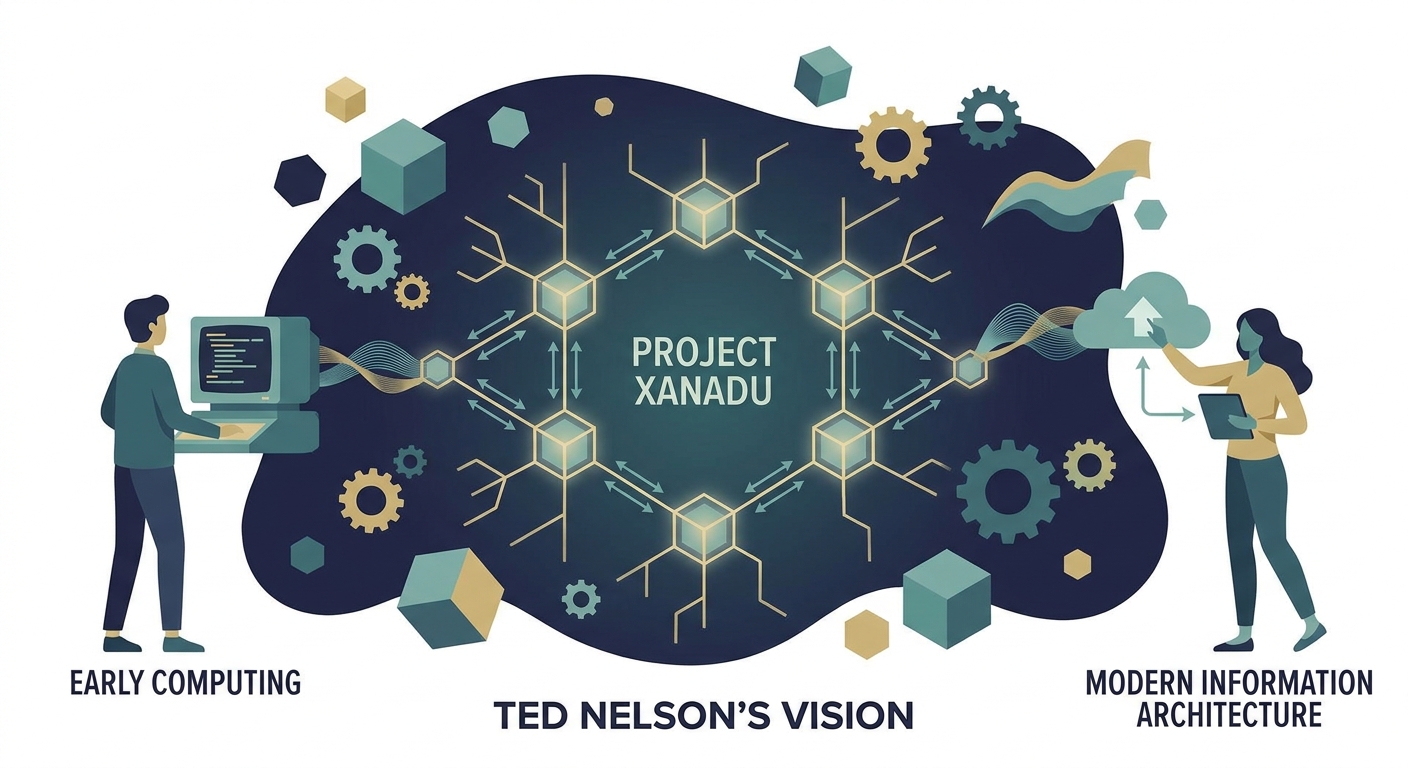
Project Xanadu is the longest-running "what-if" in computing history. Conceived by Ted Nelson in 1960, it wasn’t just another software project—it was a crusade. Nelson wanted a universal, unbreakable library for everything humans have ever written.
The World Wide Web snatched the crown by choosing "good enough" connectivity over structural integrity. But look at the modern explosion of digital knowledge tools, and you’ll realize Nelson’s original, uncompromising vision is finally having its day. We’re living in the aftermath of a web that grew too fast to remember where it came from. The features Xanadu promised—transclusion, provenance, and bidirectional linking—aren't just academic curiosities anymore. They are the missing pieces required to fix our fractured digital landscape.
What Was the Vision of the Universal Library?
Back in the early 1960s, long before the first packet of data crossed the ARPANET, Ted Nelson envisioned a "Docuverse." This wasn't a collection of static files hosted on isolated servers. It was a singular, global network where every document was connected to every other document. In Ted Nelson’s Original Manifesto, he laid out a blueprint for a system where nothing is ever truly deleted or lost.
The goal? A digital landscape where information flows like water. Compare that to the "broken" internet we have today. You move a file, and you get a 404 error. You cite a source, and you’re stuck with a fragile, manually typed link that’s likely to rot within a year.
Nelson wanted a system that mirrored the human mind: associative, non-linear, and infinitely expandable. He saw the computer not as a cold calculator, but as a medium for literature and thought—a place where the totality of human knowledge could be interlinked, annotated, and perpetually attributed to its original creator.
How Did Xanadu Propose to Fix the Internet?
Xanadu’s architecture relied on three pillars that still sound like science fiction: Transclusion, Bidirectional Linking, and Permanent Addresses. It treated content as a living entity, not a dead file.
Transclusion is the most misunderstood of these, but it is the most vital. It’s the ability to include a part of one document in another by reference, rather than by copying the data. When you "quote" someone in a standard word processor, you are duplicating their text. If they change the original, your copy remains stagnant. In a Xanadu-style system, the "copy" is just a window into the original. If the source changes, your view updates in real-time. Ownership and provenance? They stay glued to the creator.
Then there’s bidirectional linking. On the modern web, links are one-way streets. Page A points to Page B, but Page B has no structural knowledge that Page A exists. That’s why our browsing experience is so fragile. In Xanadu, every link was a two-way conversation. If you linked to a document, that document knew it was being linked to. This created an automatic "backlink" network, allowing users to trace the lineage of an idea backward through time.
Finally, the system relied on permanent addresses. In the current web, URLs are basically nicknames for locations that change constantly. Xanadu’s architecture relied on immutable identifiers. A link created in 1970 would still point to the exact same paragraph in 2026. This was the foundation of the "Universal Library"—a digital archive where context was never stripped away.
Why Is Transclusion the "Holy Grail" for Modern AI?
As we feed the world’s data into Large Language Models, we’re running headlong into a crisis of attribution. Current AI systems consume content, digest it, and regurgitate it, often stripping away the context and the author's identity. It’s the ultimate, messy "copy-paste" problem.
Transclusion solves this by changing the fundamental relationship between the source and the consumer. By referencing the original content rather than duplicating it, we create a system where attribution is baked into the architecture of the data itself.
In an AI-driven future, transclusion could allow models to "cite" their sources with a direct, live connection to the original text. It would turn the current "black box" of training data into a transparent, verifiable chain of provenance. If a model generates a summary, it wouldn't just be an approximation; it would be a transcluded view of the source material, ensuring the author gets credit and the user gets a path back to the original context.
The Great Debate: Why Did "Broken" Win Over "Perfect"?
People love to call Xanadu a failure. That’s a misunderstanding of history. Xanadu didn't "fail" in a technical sense; it lost to the World Wide Web because the Web was "good enough." Tim Berners-Lee’s design for the Web was intentionally simple. It didn't solve copyright, it didn't guarantee link persistence, and it didn't support bidirectional linking. But it was fast to deploy and easy to use.
As described in The World Wide Web vs. Xanadu, the Web succeeded because it prioritized the "network effect" over structural perfection. It allowed anyone to publish anything, even if that meant the internet would eventually become a graveyard of broken links and uncredited content.
Conversely, Nelson’s The Curse of Xanadu—as famously chronicled by Wired—was a victim of its own scope. By attempting to build a perfect system that handled micropayments, version control, and absolute link integrity all at once, the project became a victim of immense technical debt. It was a Ferrari in a world that was just learning how to ride a bicycle. The Web won because it was a tool for the masses; Xanadu looked like a tool for the gods.
Is the Modern PKM Explosion a "Xanadu Revival"?
Walk into any modern digital workspace, and you’ll see the ghost of Xanadu everywhere. Tools like Obsidian, Roam Research, and Notion are essentially building "Xanadu-lite" environments for individuals. The rise of Digital Knowledge Management has forced us to confront the same problems Nelson identified sixty years ago: how do we store, connect, and retrieve our thoughts?
Block-level referencing—the ability to link to a specific paragraph rather than an entire page—is a direct descendant of the Xanadu vision. Bidirectional linking, once a niche academic concept, is now a standard feature in note-taking apps. We are shifting away from the "surfing" mentality of the 90s—where we clicked through pages like a digital magazine—to a "structuring" mentality, where we build webs of personal knowledge. We aren't just reading the web anymore; we are curating it, connecting it, and treating our notes as a personal "Docuverse."
What Lessons Can We Learn for Future Web Architecture?
The primary lesson of Xanadu is that data integrity is not a luxury; it is a necessity for the long-term health of our information systems. We are currently living with the consequences of a web built on "link rot"—the tendency for URLs to die over time. As we look toward the Future of Web Linking, we have to ask if our current methods of content storage are sustainable.
We need to move toward a model where content is decoupled from its location. If we can adopt decentralized identifiers and link-resilient architectures, we might finally claw back some of the stability Nelson envisioned. Xanadu teaches us that the structure of the web should be as durable as the knowledge it contains.
How Can You Experience Xanadu Today?
If you want to see the vision in action, you don't need a time machine. The OpenXanadu Prototype is a functional, albeit experimental, interface that demonstrates the power of transclusion. It allows you to see how a document can be composed of parts from other documents, all while maintaining a clear, navigable trail back to the source.
While it isn't a browser you’ll use to check your email, it serves as a powerful reminder of what is possible when we stop viewing documents as static files and start viewing them as interconnected nodes in a living, breathing library.
Frequently Asked Questions
What is Project Xanadu and why did it take 50+ years to develop?
Project Xanadu was the first attempt to create a global, interconnected hypertext system. It took decades because it was an incredibly ambitious project that required hardware and software capabilities that didn't exist in the 1960s. The scope kept expanding as computing evolved, leading to it being labeled "vaporware" for many years.
Did Xanadu fail because of the World Wide Web?
In a sense, yes. The World Wide Web offered a simplified, pragmatic version of hypertext that was easy to implement and spread rapidly. Xanadu’s design philosophy was built on "total completeness," which, while arguably superior in its architecture, was too complex for the early, rapid-growth phase of the internet.
What is "Transclusion" and why does it matter?
Transclusion is the inclusion of a part of one document within another by reference. It matters because it eliminates the need for duplication, ensures that the original author is always credited, and allows for live, real-time updates to content across the entire network.
Can I actually use Xanadu today?
Yes, you can explore the OpenXanadu prototype online. However, it is an experimental scholarly tool designed to demonstrate the concepts of hypertext and transclusion, not a full-featured replacement for your standard web browser.
How does Xanadu relate to modern tools like Notion or Obsidian?
Modern PKM tools have adopted many of Xanadu’s core ideas, specifically block-level referencing and bidirectional linking. These tools allow users to create personal "Docuverses" that mirror the associative, non-linear way Ted Nelson envisioned the entire web working decades ago.