How to Rank on ChatGPT: A Practical GEO Guide

TL;DR
- ✓ Shift your strategy from acquiring website clicks to becoming an AI-cited authority source.
- ✓ Structure content with the inverted pyramid method to improve LLM parsing and retrieval.
- ✓ Replace fluffy marketing jargon with high-density, declarative facts to strengthen vector embeddings.
- ✓ Optimize for the citation economy by providing direct, high-confidence answers to user queries.
Forget the "click." Seriously. If you’re still obsessing over how to lure a user away from a search engine and onto your site, you’re fighting a war that ended two years ago.
We’ve entered the age of Generative Engine Optimization (GEO). The goal isn't to get the user to visit you; it’s to become the source of truth that the AI synthesizes into its final answer. If your content isn't built to be consumed by a machine, you’re invisible. Period.
The End of the "Ten Blue Links" Era
For twenty years, we lived in the cult of the blue link. We stuffed keywords into meta tags, begged for backlinks, and optimized for the fleeting attention of someone skimming a results page. That era is dead. Today, AI search adoption trends prove that users are skipping lists entirely. They want an answer, they want it now, and they want it conversational.
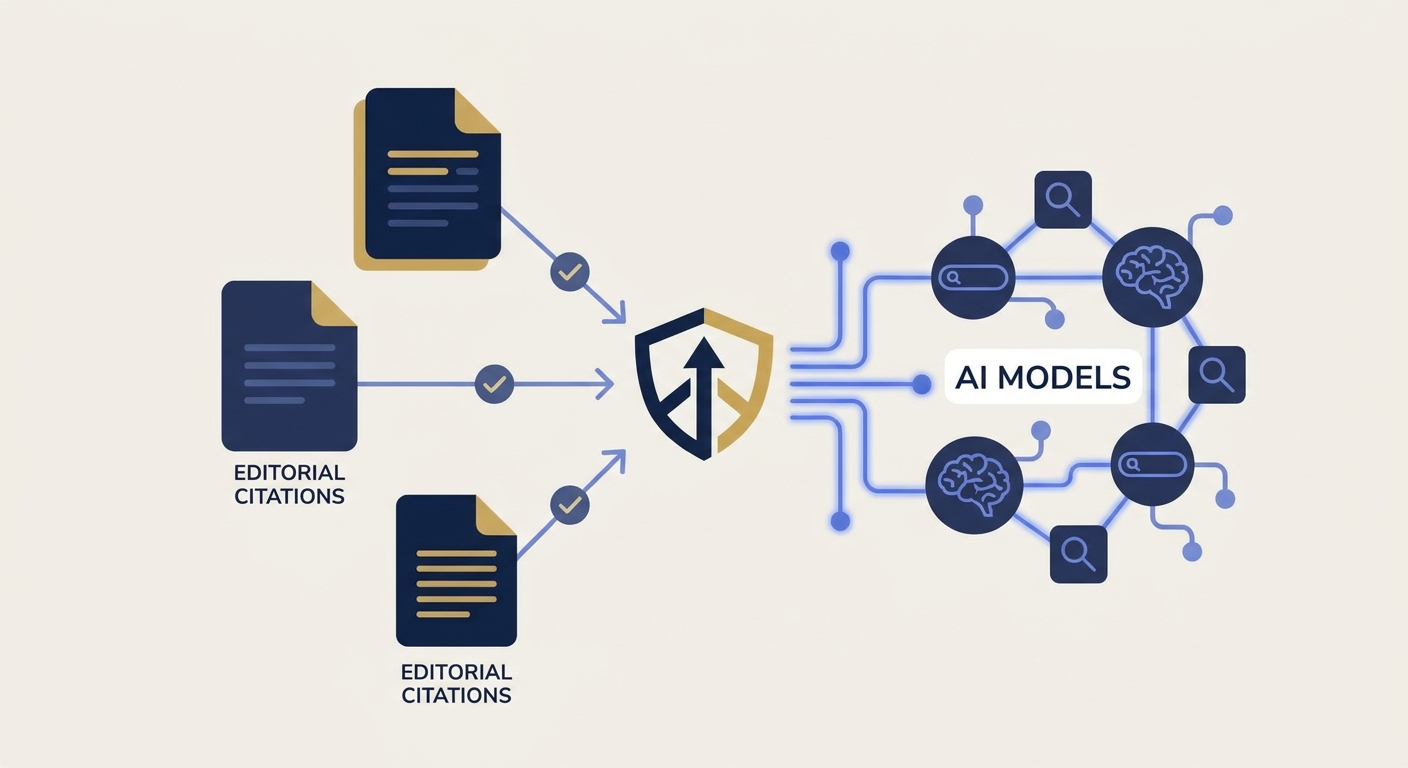
This is a massive psychological shift. When a user asks a complex question, they don't want to play librarian and aggregate data from ten different tabs. They want the AI to do the heavy lifting. If your brand isn't providing the raw material for that answer, you don't exist. We’ve moved from the "Traffic Economy" to the "Citation Economy." Your new metric of success? Being cited as the authority.
What is GEO and Why Does It Matter in 2026?
GEO is the art of structuring information so that Large Language Models (LLMs) can easily index, retrieve, and—most importantly—attribute it to you.
This isn't just some marketing buzzword. The seminal Princeton Research Paper: GEO proved that specific structural changes—like offering direct, declarative answers and grounding content in primary data—can boost your visibility by over 30%. Think of an LLM as a probabilistic engine hunting for high-confidence patterns. Your job is to stop writing for humans who might click and start writing for models that must verify.
How Do Generative Engines Actually "Read" Your Content?
Here’s the secret: they don’t "read." They convert your text into vector embeddings—mathematical representations of meaning. When a user throws a query at a system, the engine performs a "vector search" to find nodes of information that align with that intent.
Anything fluffy? Anything repetitive? Anything that’s just keyword-stuffed SEO trash? That’s your enemy. It dilutes your vector embedding and makes it impossible for the model to "pinpoint" your expertise. You need the principles of high-density content to ensure every single paragraph earns its keep. If you’re writing a guide on fixing a leaky faucet, don’t bore the AI with the history of plumbing. Give it the step-by-step procedure. Give it the tools. Cut the marketing jargon.
How Can You Optimize Your Content for AI Visibility?
1. Structure Your Data for LLM Parsing
Hierarchy is your strongest signal. Use the "Inverted Pyramid"—lead with the definitive answer, follow with supporting evidence, and save the granular details for the end. LLMs are biased toward the top of the page. If you bury the lead under three paragraphs of fluff, the model will skip you for a source that gets to the point.
Schema markup is your bridge to the future. Use JSON-LD to define your entities, dates, and data points. It’s the map the AI uses to navigate your content.
2. Can You Force an AI to Cite Your Brand?
"Force" is a strong word, but yes, you can influence it. AI engines prioritize accuracy and trust. To get that citation, you need to provide the fuel: proprietary data, original statistics, and rock-solid, declarative statements. An LLM is a sucker for a study that says, "X results in Y, according to our survey of 5,000 users."
Write "citeable snippets." These are standalone, 20-30 word sentences that summarize a complex concept perfectly. When an LLM generates a response, it’s looking for blocks of text it can drop directly into its output. Modern engines handle source attribution by hunting for these high-confidence snippets.
3. Optimize Visuals for AI Interpretation
We’re in a multi-modal world. An LLM can't "see" your image, but it can read the metadata describing it. If you have a chart, provide a detailed text description in your alt-text and a summary of the findings in the surrounding content. Don’t just post a graph; write a sentence that says: "As shown in Figure 1, software adoption increased by 40% between 2024 and 2026." That’s how you bridge the gap.
The "Don'ts" of GEO
Stop trying to force legacy SEO into a GEO environment.
- Keyword stuffing is toxic. Models are trained to spot unnatural repetition. If it looks like a machine wrote it, the machine will ignore it.
- Ditch the fluff. Stop starting articles with "In the ever-evolving landscape." The AI doesn't care about the landscape. It cares about data. If a sentence doesn't inform, it detracts.
How Do You Measure Success in a Non-Click World?
This is the hardest pill to swallow. You’re trading CTR (Click-Through Rate) for "Brand Mention Frequency" and "Citation Rate." You need to move away from tracking traffic and start tracking authority.
As we note in our SEO Services for AI-ready strategies, this requires a fundamental shift. You aren't playing the traffic game anymore; you're playing the reputation game.
The GEO Audit: A Practical Checklist
Before you hit publish, run your content through this audit. If you can’t say "yes" to these, you’re invisible.
Future-Proofing Your Brand for the AI-First Web
The winners over the next five years will be the "Information Hubs." Stop seeing your website as a funnel and start seeing it as a library of verified, structured knowledge. When you stop chasing the click and start chasing the citation, you stop fighting for page-one rankings and start winning the mindshare of the user.
That is the only way forward.
Frequently Asked Questions
What is the primary difference between SEO and GEO?
SEO is focused on driving traffic to a website through search engine rankings, while GEO is focused on providing high-density, authoritative content that AI models will extract and cite as the answer to a user's query.
How can I tell if my brand is being cited by ChatGPT?
You can track brand mentions within AI-generated responses using specialized AI-monitoring tools or by manually querying your core topics in LLMs to see if your proprietary data or brand name is consistently cited as an authoritative source.
Does traditional SEO help or hurt my chances of ranking on ChatGPT?
Traditional SEO helps if it is focused on quality and structure (like schema and H-tag hierarchy), but it hurts if it relies on keyword stuffing, thin content, or clickbait tactics that the AI identifies as low-quality or irrelevant.
What is the single most important factor for getting cited by AI?
Information density. LLMs prioritize sources that provide direct, verifiable, and unique factual data that answers the user's prompt without unnecessary filler.
How do I measure my ROI from AI search visibility?
ROI in the GEO era is measured by "Citation Rate" and "Brand Mention Frequency" rather than traditional website sessions. You must track how often your brand is surfaced as an authoritative source in conversational AI responses.