How to Audit Your Link Profile for Better SEO Performance Tracking


TL;DR
- ✓ Treat backlink audits as strategic growth blueprints rather than simple cleanup tasks.
- ✓ Monitor your link velocity to ensure your growth pattern remains natural and sustainable.
- ✓ Triangulate data using Google Search Console and Ahrefs for a complete profile view.
- ✓ Prioritize topical proximity between linking pages and your content to build authority.
A backlink audit in 2026 isn't some tedious chore you do to keep the office clean. It’s a tactical reconnaissance mission. If you’re still approaching your link profile with a "cleanup first" mentality, you’re just treating the symptoms while the disease spreads.
Search algorithms have evolved. They aren't just filtering out spam anymore. They are mapping your site’s topical authority and sniffing out the patterns that connect your content to high-ranking hubs. Stop worrying about penalties and start looking for growth. When you treat an audit as a blueprint for future acquisition rather than a frantic exercise in damage control, you stop playing defense and start building an empire.
Why Is a Backlink Audit Still Essential in the Age of AI?
We’ve moved past the "link volume" wars. It’s no longer about who has the most links; it’s about who has the most relevant ones. While Google’s AI is getting better at ignoring low-quality noise, the human element—the actual trust signal—is still the final judge.
In 2026, the biggest reason to audit is to understand your "Link Velocity." This is the rhythm of your growth. If you’re picking up new links at a steady clip, you’re golden. But if your velocity spikes without a corresponding surge in your content output or PR, you’re going to trip the alarm. Take a look at the Google Search Central: Link Schemes documentation if you need a reminder. It’s not about "getting links." It’s about building a profile that screams expertise. An audit is your diagnostic tool—it tells you if you’re building a legacy or just stacking sandcastles.
What Tools Do You Need to Conduct a Professional-Grade Audit?
You can’t optimize what you can’t see. Relying on one data source is how you end up with massive blind spots. You need a triangulated view of your backlink world.
Start with the raw data from Google Search Console. It’s the source of truth for what Google actually sees. But keep in mind, it’s a bit retrospective. It’s looking in the rearview mirror. To see what’s coming up alongside you, pair it with the Ahrefs Backlink Checker. That’ll show you the referring domains interacting with your competitors.
Don't stop at link data. You need to know the technical health of the pages you're linking to. A backlink pointing to a page that crashes or fails Core Web Vitals is a waste of time—it’s an invitation for the user to hit the 'back' button. If you’re looking to scale this, our SEO Audit Services can handle the heavy lifting, but the logic remains the same: cross-reference your link equity with your site speed and mobile performance.
Step 1: How Do You Map Your Backlinks to Topical Authority Hubs?
Most SEOs treat all backlinks like the same currency. They aren't. In 2026, a link is only as strong as the topical proximity between the linking page and your content.
Segment your backlinks into "Content Clusters." Is the link coming from a site that lives and breathes your industry? Or is it just some generic footer link from a site that covers everything from vacuum repair to crypto trading? Use AI to help you categorize these. If a link doesn't contribute to your topical authority, toss it into the "noise" pile and forget about it.
Step 2: How to Identify and Evaluate "Toxic" Link Signals?
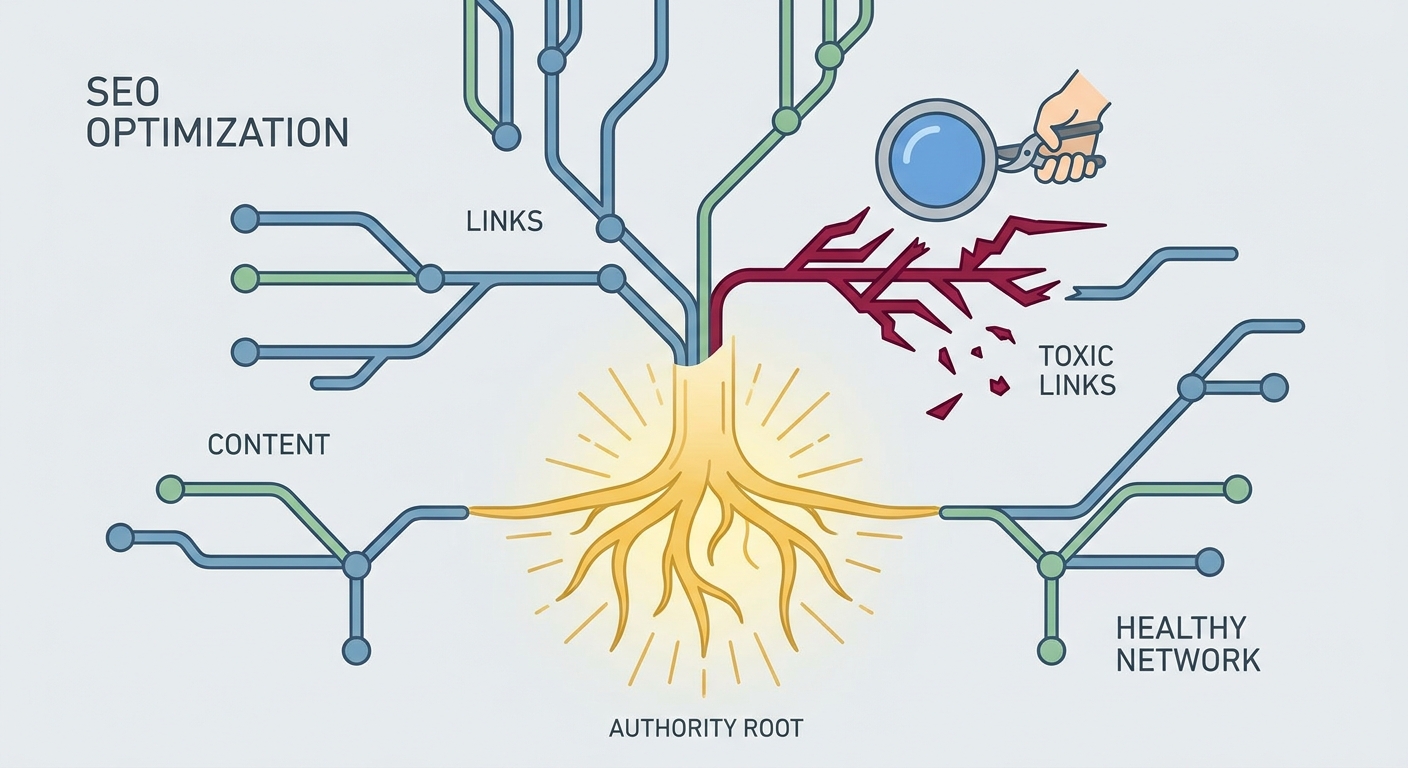
The industry has been obsessed with "toxic" links for years, leading to a lot of unnecessary disavowing. Here is the reality: modern algorithms are smart enough to ignore the trash. You only need to step in when there is clear, malicious intent. Think: a massive, unnatural flood of links from obscure, unrelated gambling or adult sites. That’s the only time you should be hitting the panic button.
A healthy profile is a messy, diverse one. You want a mix of dofollow, nofollow, sponsored, and ugc tags. If 99% of your links are dofollow, you’ve been over-optimizing. That’s a red flag. Real growth happens in the wild—on forums, social media, and random citations. Don't go on a disavow rampage against every low-DR site you find. Save your energy for the coordinated campaigns that target your money pages.
Step 3: Why Anchor Text Distribution is the Key to Avoiding Over-Optimization
Your anchor text is the label you put on your content. If every single link to your "Best Running Shoes" page says "Best Running Shoes," you are practically begging for a manual review. You’re telling the algorithm exactly what you’re trying to rank for, and that’s the classic sign of a manufactured, artificial profile.
Keep it natural. Lean on your brand name. Use naked URLs. Let the "Exact Match" anchor text sit low—ideally under 5-10% of your total profile.
By keeping your distribution broad, you let the algorithm connect the dots, associating your site with a wide range of queries instead of pinning you to a single, easily filtered keyword.
Step 4: How to Use Audit Data to Scale Your Growth Strategy
Once you’ve cleared the noise, the audit turns into a roadmap. Look for "Link Gaps"—those sites that link to your competitors but have ignored you. This is the low-hanging fruit.
Transitioning from "cleaning" to "building" is where the magic happens. If your audit shows that your top-performing content is getting love from niche-specific blogs, then you know exactly what to do next: double down. For some inspiration on how to move forward, check out our Link Building Strategies guide. It’s all about turning these insights into active campaigns that actually move the needle.
Case Study: Moving From Recovery to Ranking Authority
We once worked with a mid-sized e-commerce site that lost 30% of its traffic after a series of aggressive, automated link-building "hacks." The site was a mess of Exact Match anchors and irrelevant, low-quality domains.
We didn't just nuke the whole profile. We performed a granular audit to separate the trash from the treasure. We found that the site had actually earned some genuinely high-authority links that were being buried under the spam. By disavowing the toxic outliers and pivoting the content to support the high-relevance clusters we identified, the site saw a 45% traffic recovery in just six months. The lesson? An audit isn't about hiding; it’s about curating your reputation so it matches the actual quality of your brand.
Frequently Asked Questions
How often should I conduct a backlink audit?
Quarterly is the sweet spot for most. If you’re in a cutthroat industry or pushing hard on growth, go monthly. You need to keep an eye on your link velocity so you can catch negative SEO attacks before they gain traction.
Is the Disavow Tool still relevant in 2026?
Yes, but treat it like a scalpel, not a sledgehammer. Only use it when you’ve identified a sustained, malicious attack that is actively hurting your rankings.
What defines a "toxic" backlink in the current Google algorithm?
A toxic link is one that clearly violates spam policies—think paid link schemes, PBNs, or those "ghost" sites that exist only to host links. If it looks like it was built for bots instead of humans, it’s a candidate for a disavow.
Can a backlink audit directly improve my Google rankings?
The audit itself is just information. But the actions you take based on that information—cleaning up bad anchors and pursuing high-quality targets—are some of the most effective ways to clear the path for better rankings.
How does "Link Velocity" affect my site's trust signals?
Link velocity is a measure of trust. A sudden, massive spike in links from nowhere looks fake. A steady, consistent growth pattern that matches the release of your high-quality content? That signals to Google that you’re the real deal.