What are the 10 types of knowledge management strategies?

TL;DR
- ✓ Learn why a formal knowledge management strategy is essential for organizational growth.
- ✓ Discover how to transition from data hoarding to efficient, AI-driven knowledge flow.
- ✓ Explore ten practical strategies to break silos and foster a sharing culture.
- ✓ Understand how to leverage gamification and networking to improve team collaboration.
Knowledge management (KM) is just a fancy term for making sure the right people have the right answers at the exact second they need to make a move. It’s the bridge between what your company knows and what it actually produces. Stan Garfield, one of the sharpest minds in this space, once said, "Although culture eats strategy for breakfast, defining a strategy is a requirement for implementing a successful KM program."
He’s right. But the rules have changed. In 2026, we’re finally moving away from those bloated, clunky file servers that nobody uses. We’re shifting toward intelligent, discovery-based systems where AI acts as the connective tissue. Choosing the right strategy isn't a chore for the HR or IT department—it’s the difference between your business scaling up or collapsing under its own weight.
Why Does Your Organization Need a KM Strategy?
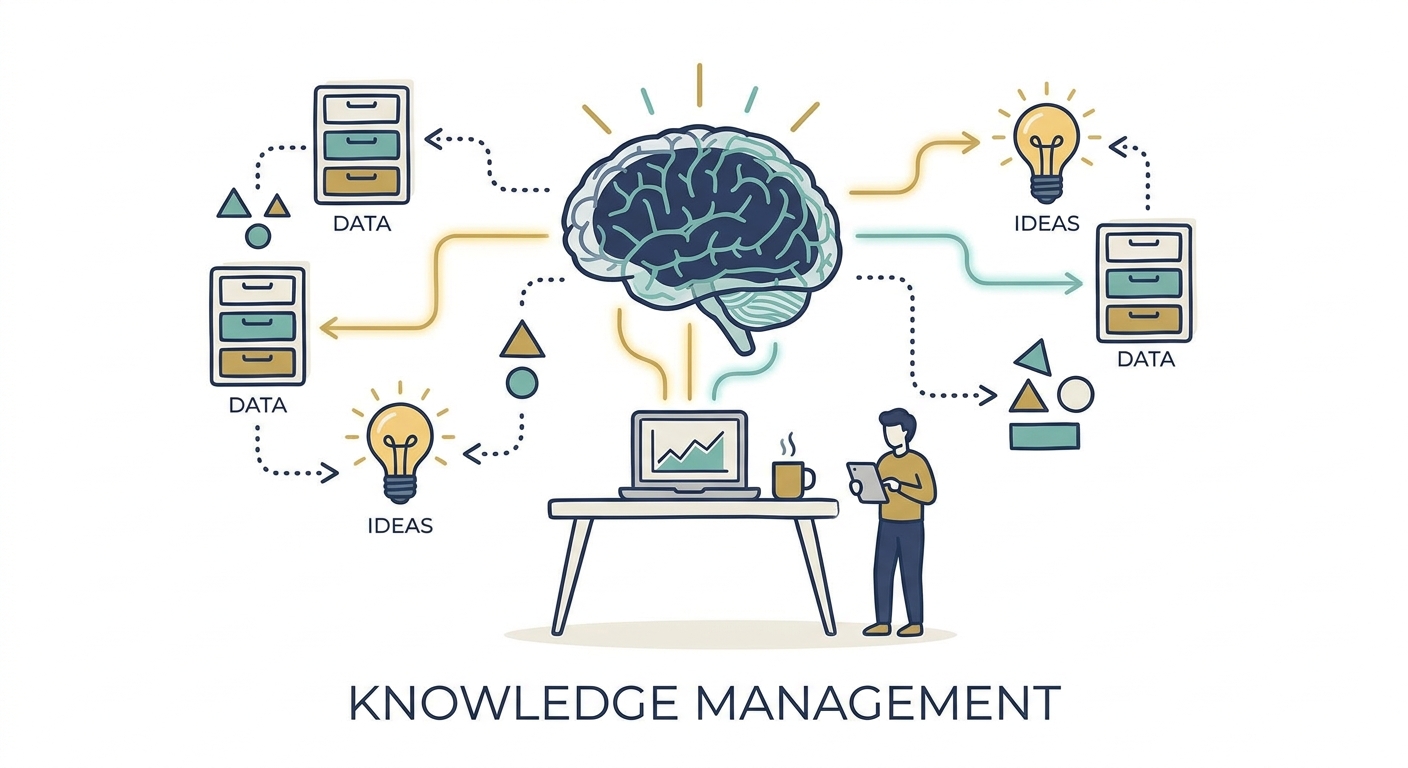
Most companies have "data obesity." They hoard every email, spreadsheet, and slide deck like digital packrats, yet nobody can find a damn thing when they need it. A formal KM strategy acts as a filter. It shifts your focus from hoarding to flow. When you anchor your approach in proven industry best practices, you stop treating knowledge as a byproduct of work and start treating it like the engine of your business.
Without a strategy, your team is stuck in a labyrinth of half-forgotten Slack messages, outdated wikis, and buried email chains. A strategy is the map that turns all that noise into something you can actually use.
The 10 Types of Knowledge Management Strategies: A Toolkit
Don’t treat these ten strategies like a rigid checklist. Think of them as a toolkit. You don’t need to use every tool in the box every day, but you’d better know which one to reach for when your growth hits a wall.
1. Motivate: How do you drive a culture of sharing?
Knowledge hoarding isn't usually malicious. It’s a symptom of a system that rewards the "lone wolf" over the team. To break this, you have to bake sharing into the workflow. Forget empty "we are a team" slogans. Use gamification, public shout-outs, and—most importantly—tie knowledge sharing to performance reviews. If an engineer’s promotion depends on their contribution to the team’s knowledge base, you’d better believe they’ll prioritize documentation.
2. Network: How do you connect people across silos?
In a remote or hybrid world, the water cooler is gone. You have to manufacture those connections. The Network strategy focuses on creating digital spaces where trust can grow. This means building communities of practice, internal mentorship programs, and social discovery tools that help people find "someone who knows" rather than just "a document that explains."
3. Supply: How do you capture knowledge at the source?
This is the baseline. It’s the mechanics of getting information out of a brain and into a system. The goal? Frictionless capture. If a process takes ten steps to document, it won’t happen. Use templates, automated transcriptions, and "capture-in-the-flow" tools that let experts record their expertise while they’re already doing the work.
4. Analyze: How do you make sense of existing data?
You have thousands of files, but do you know what they actually say? The Analyze strategy is about auditing your knowledge health. It’s about spotting patterns. What is your team searching for? More importantly, what are they not finding? If your search logs show a spike in questions about a specific legacy process, that’s your signal to stop what you’re doing and document it.
5. Codify: How do you structure knowledge for scale?
Codification is about turning the "how-to" into a repeatable, scalable asset. Whether it’s a standard operating procedure (SOP), a coding style guide, or a sales playbook, codifying ensures quality stays high, regardless of who is doing the work. This is the bedrock of scaling without losing the "secret sauce" that made you successful in the first place.
6. Disseminate: How do you ensure the right knowledge reaches the right person?
This is the classic "push vs. pull" dilemma. Pull strategies wait for users to go looking; push strategies deliver the goods proactively. In a modern office, the best dissemination is context-aware. If an employee opens a project management tool, the system should automatically surface the relevant templates and guidelines. Don't make them hunt for it. Bring the knowledge to them.
7. Demand: How do you identify what the organization actually needs?
Stop building giant repositories of information that nobody asked for. The Demand strategy flips the script. By analyzing support tickets, help desk requests, and project bottlenecks, you can map out exactly what knowledge is missing. This ensures your experts spend their time documenting the right things, not just the things they feel like writing about.
8. Act: How do you turn knowledge into business results?
Knowledge is worthless if it stays in a browser tab. The Act strategy is about closing the loop. It’s the process of applying "lessons learned" to current workflows. After every project, run a rigorous post-mortem that leads to an immediate update to your processes. If you don't change how you work based on what you’ve learned, you aren't doing knowledge management. You’re just keeping a diary.
9. Invent: How do you foster innovation?
Innovation happens at the intersection of different ideas. The Invent strategy creates environments where employees can collide. Host hackathons, "innovation hours," or cross-departmental workshops. Force collaboration between marketing and back-end engineering, and you’ll create the friction necessary to spark ideas that would never emerge in a siloed environment.
10. Augment: How does AI enhance the other nine strategies?
AI isn't a strategy itself; it’s a force multiplier for the other nine. By leveraging AI-driven trends in 2026, you can automate the heavy lifting. AI can transcribe meetings (Supply), tag legacy documents (Codify), and provide instant answers to employees (Disseminate). It enhances team collaboration by removing the cognitive load of searching, letting your people focus on high-value synthesis.
How to Implement Your KM Strategy in 2026
Most organizations treat KM as a project with a start and end date. That’s a mistake. It’s a living process.
Step 1: Audit your current state. Before you buy a new tool, look at how people actually work. Where do they go when they have a question? Often, it’s a private DM to a senior employee. That is your "shadow" KM system. Acknowledge it.
Step 2: Align with business goals. Your KM strategy must serve a business objective. If your goal is to reduce customer churn, your KM strategy should focus on "Demand" and "Act"—identifying why customers leave and training support teams to solve those specific problems. Consult our KM Implementation Guide to align your efforts with your KPIs.
Step 3: Choose your primary strategy mix. A startup in hyper-growth needs to prioritize "Invent" and "Network" to keep the culture agile. A mature enterprise with high turnover needs to double down on "Codify" and "Disseminate" to ensure operational continuity.
Overcoming Implementation Pitfalls
The biggest enemy of KM is "tool fatigue." Do not introduce a new platform without first establishing the cultural habit of sharing. If you force a tool on a team that hasn't bought into the value of sharing, they will treat it as a graveyard for documents.
Start small. Pick one department, solve one persistent pain point using one of the strategies above, and prove the value. Once the team sees that sharing knowledge makes their lives easier—not just busier—they will become your strongest advocates. Avoid the temptation to over-engineer. In the era of AI, a simple, searchable, and clean index is more powerful than a complex, layered taxonomy that no one understands.
Frequently Asked Questions
What is the most important knowledge management strategy for a remote team?
Focus on the "Network" strategy. In a remote setting, the informal "water cooler" knowledge transfer is lost; the strategy must be intentional, focusing on digital trust and cross-silo connection to replace the spontaneous interactions that used to happen in the office.
How do AI-driven tools change traditional KM strategies?
AI shifts the burden from manual "Supply" to automated "Analyze" and "Augment." By using LLMs and vector search, organizations can provide context-aware answers rather than forcing users to search through static documents.
Can you have a KM strategy without a dedicated KM tool?
While a strategy exists in theory, scaling it without a tool is nearly impossible. A strategy defines the "what" and "why," but the tool provides the "how" by making knowledge accessible and searchable.
Which comes first: the KM culture or the KM strategy?
They are cyclical. A strategy provides the structure to begin changing culture, but if the existing culture is fundamentally resistant to sharing, even the best strategy will fail. Start with a strategy that highlights quick wins to prove value to the culture.
Conclusion
The shift toward active, AI-augmented knowledge management isn't a luxury—it’s the baseline for competitive survival in 2026. Stop the "storage" mindset. Embrace a multifaceted strategy that includes everything from human-centric networking to AI-driven augmentation. Look at your operations today. Identify the one strategy among the ten that is missing, and make that your focus for the next quarter. The gap you close today will be the competitive advantage you reap tomorrow.